ADB is a multilateral development finance institution dedicated to reducing poverty in Asia and the Pacific. Established in 1966, They are now owned by 62 members. Headquarters is in Manila and having 24 other offices around the world.
http://www.adb.org/
One of the Biggest Bank in the Arab Country. They have worldwide offices in 27 Countries. For more details
http://www.arabbank.com/
The reason Bank of America is in business is to help make communities stronger and to help people achieve their dreams. We fulfill this purpose by reaching for higher standards in everything we do -- for our customers, our shareholders, our associates and our communities, upon which the future prosperity of our company rests."
http://www.bankofamerica.com/
To provide superior, proactive banking services to niche markets globally, while providing cost-effective, responsive services to others in our role as a development bank, and in so doing, meet the requirements of stakeholders.
http://www.bankofindia.com/
Bank One is one of the nation's leading financial institutions. Our growth allows us to focus on continuing to innovate and enhance customer service.
http://www.bankone.com/
ANZ is one of the largest companies in Australia and New Zealand and a major international banking and financial services group, which is among the top 100 banks in the world.ANZ world headquarters is located in Melbourne, where it first opened an office as the Bank of Australasia in the 1830s.ANZ's impressive history stretches back over 150 years and involves dozens of different banks.
http://www.anz.com/
The World Bank Group’s mission is to fight poverty and improve the living standards of people in the developing world. It is a development Bank which provides loans, policy advice, technical assistance and knowledge sharing services to low and middle income countries to reduce poverty. The Bank promotes growth to create jobs and to empower poor people to take advantage of these opportunities.
http://web.worldbank.org/

The Islamic Development Bank is an international financial institution established in pursuance of the Declaration of Intent issued by the Conference of Finance Ministers of Muslim Countries held in Jeddah in Dhul Q'adah 1393H, corresponding to December 1973. The Inaugural Meeting of the Board of Governors took place in Rajab 1395H, corresponding to July 1975, and the Bank was formally opened on 15 Shawwal 1395H corresponding to 20 October 1975.
http://www.isdb.org/
The European Central Bank and the national central banks together constitute the Eurosystem, the central banking system of the euro area. The main objective of the Eurosystem is to maintain price stability: safeguarding the value of the euro.
http://www.ecb.int/
Deutsche Bank is one of the leading international financial service providers. With 69,300 employees, the bank serves more than 13 million customers in 76 countries worldwide; more than half of the bank's staff work outside Germany.
http://www.deutsche-bank.de/index_e.htm
ICICI Bank is India's second-largest bank with total assets of about Rs.112,024 crore and a network of about 450 branches and offices and about 1750 ATMs. ICICI Bank offers a wide range of banking products and financial services to corporate and retail customers through a variety of delivery channels and through its specialised subsidiaries and affiliates in the areas of investment banking, life and non-life insurance, venture capital, asset management and information technology. ICICI Bank's equity shares are listed in India on stock exchanges at Chennai, Delhi, Kolkata and Vadodara, the Stock Exchange, Mumbai and the National Stock Exchange of India Limited and its American Depositary Receipts (ADRs) are listed on the New York Stock Exchange (NYSE).
http://www.icicibank.com/
Headquartered in London, HSBC Holdings plc is one of the largest banking and financial services organisations in the world. HSBC’s international network comprises over 9,500 offices in 79 countries and territories in Europe, the Asia-Pacific region, the Americas, the Middle East and Africa.With listings on the London, Hong Kong, New York and Paris stock exchanges, shares in HSBC Holdings plc are held by nearly 200,000 shareholders in some 100 countries and territories. The shares are traded on the New York Stock Exchange in the form of American Depositary Receipts.Through an international network linked by advanced technology, including a rapidly growing e-commerce capability, HSBC provides a comprehensive range of financial services: personal financial services; commercial banking; corporate, investment banking and markets; private banking; and other activities.
http://www.hsbc.com/
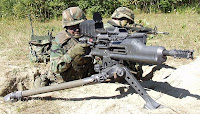 XM307 is an Advanced Crew Served Weapon or ACSW which has a massive fire-power with 25mm belt-fed ammunition which
 They call it the weapon of 21 st century. It was developed in 2001 by the Belgian manufacturer Fabrique Nationale.
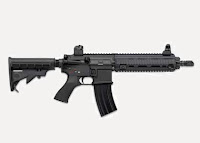 Heckler & Koch HK416 assault rifle Improved version of M4 Carbine now features a new style gas system. Designed by U.S. Army's Delta force and German arms it all got a shape in 2004 when the new rifle was designed. This rifle is currently being used in combat in over six countries. Using 5.56x45mm NATO rounds and with fire rate of 700-900 rounds per minute it makes it a really deadly weapon.
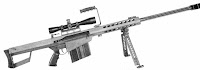
 The AS50 is a long range sniper rifle using .50 cal ammunition. It is the latest product of British firearms producer Accuracy International and was designed and produced in 2006.